
Informe Derrotero Australis


INFORME DERROTERO AUSTRALIS
Carlos Damacio Gómez
A graphic investigation from the archive and the document on the origin of a founding fiction of Patagonia: The City of the Caesars.
My work starts from a simple question: what made people search for 300 years for a city that never existed?
The answer is not in Patagonia. It is on paper.
The project articulates engraving, intervened cartography and apocryphal documents to trace the genealogy of that search. A genealogy that is at once epic, genocidal and syncretic.
The archive as matrix:
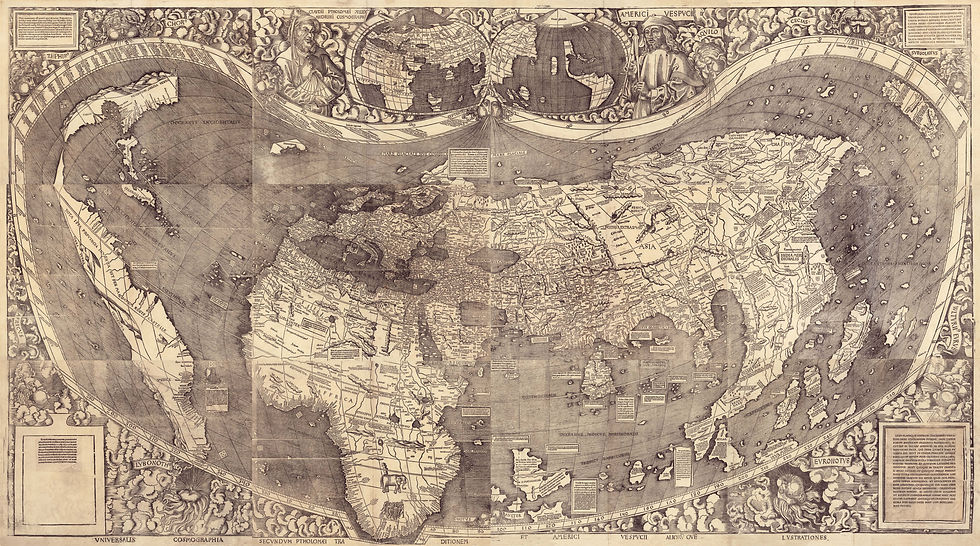
I take as a starting point Waldseemüller's Carta Marina (1516). There, as we have seen, America is already divided between two monstrosities: the cannibal — Terra Canibalor — and the anomalous — the opossum. That matrix is key: the American territory is inscribed as an inversion of the European natural order. Everything that lies further south of that mark will be, by definition, more monstrous and more desirable.
From there, the derrotero — the pilot chart, the route — unfolds:
Magellan and Pigafetta (1520): They invent the Patagon. A man ten feet tall, with enormous feet, voice like a bull. It is not a description, it is a narrative necessity. If the land is terra incognita — as Waldseemüller leaves it — it needs a guardian to its scale. The giant legitimizes the unexplored.
Alonso de Ovalle (1646): In his Histórica Relación del Reyno de Chile, Ovalle fixes the imaginary. Chile as a temperate, fertile territory, analogous to Europe, but interrupted by austral barbarism. His cartography is theological: the south is where civilization ends and the mission begins.
Nicolás Mascardi (1670): The Jesuit who, from Chiloé, searches for the Caesars to convert them. His archive — letters, handwritten derroteros, confessions of Mapuche and Poya prisoners — is the heart of the project. Mascardi dies pierced by arrows while looking for a white city he saw on a map. His death turns fiction into martyrdom, and martyrdom into proof of existence.
Athanasius Kircher (1665): In his Mundus Subterraneus, Kircher draws a hollow world connected by subterranean fires. That idea directly feeds the myth of the Caesars: a city of gold hidden under the Andes, lit by volcanoes, reached through tunnels. Syncretism is not only religious, it is geological.
My work with engraving operates on that tension.
I do not illustrate the City of the Caesars. I work on the documents that invented it. I intervene in the plates of Ovalle, Kircher and Waldseemüller. I trace them, wear them down, superimpose them. Santiago — dust, zenithal light, university archive — is printed over Łódź — textile factory, fog, weave. One distance over another.
Engraving, in this case, is not a representation of landscape. It is its failed translation system. The matrix reveals its wear, its error, its erasure. And there appears what official cartography tried to erase:
The aborigine versus the conquistador.The savage barbarian versus civilization.The body of the giant versus the body of the archive.
Report / Austral Pilot Chart proposes that the exploration of the New World was not triggered by the desire to discover, but by the search for concrete material matters — gold, spices, souls — sustained by a paper epic. The City of the Caesars is the perfect engine: it justifies expansion, genocide and mission, because it is always a little further south.
My proposal for Łódź is to generate an experience of re-reading and re-signification: that the European viewer does not see Patagonia, but sees how Europe imagined Patagonia in order to occupy it. And that in this superposition of distances — Santiago as an intangible imaginary, Łódź as an active support — landscape ceases to be the visible and becomes what we were made to believe we should see.
Informe Derrotero Australis es una investigación gráfica desde el archivo y el documento sobre el origen de una ficción fundante de la Patagonia: La Ciudad de los Césares.
Mi trabajo parte de una pregunta simple: ¿qué hizo que se buscara durante 300 años una ciudad que nunca existió?
La respuesta no está en la Patagonia. Está en el papel.
El proyecto articula grabado, cartografía intervenida y documento apócrifo para trazar la genealogía de esa búsqueda. Una genealogía que es a la vez épica, genocida y sincrética.
El archivo como matriz:
Tomo como punto de partida la Carta Marina de Waldseemüller (1516). Ahí, como vimos, América ya aparece dividida entre dos monstruosidades: el caníbal —Terra Canibalor— y el anómalo —la zarigüeya. Esa matriz es clave: el territorio americano se inscribe como inversión del orden natural europeo. Todo lo que esté más al sur de esa marca será, por definición, más monstruoso y más deseable.
A partir de ahí, el derrotero se despliega:
Magallanes y Pigafetta (1520): Inventan al Patagón. Un hombre de tres metros, con pies enormes, voz de toro. No es una descripción, es una necesidad narrativa. Si la tierra es incógnita —terra incognita como la deja Waldseemüller— necesita un guardián a su escala. El gigante legitima lo inexplorado.
Alonso de Ovalle (1646): En su Histórica Relación del Reyno de Chile, Ovalle fija el imaginario. Chile como territorio templado, fértil, análogo a Europa, pero interrumpido por la barbarie austral. Su cartografía es teológica: el sur es donde termina la civilización y empieza la misión.
Nicolás Mascardi (1670): El jesuita que, desde Chiloé, busca a los Césares para convertirlos. Su archivo —cartas, derroteros manuscritos, confesiones de prisioneros mapuche y poya— es el corazón del proyecto. Mascardi muere atravesado por flechas buscando una ciudad blanca que vio en un mapa. Su muerte convierte la ficción en martirio, y el martirio en prueba de existencia.
Athanasius Kircher (1665): En su Mundus Subterraneus, Kircher dibuja un mundo hueco conectado por fuegos subterráneos. Esa idea alimenta directamente el mito de los Césares: una ciudad de oro escondida bajo los Andes, iluminada por volcanes, a la que se llega por túneles. El sincretismo no es solo religioso, es geológico.
Mi trabajo con el grabado opera sobre esa tensión.
No ilustro la Ciudad de los Césares. Trabajo sobre los documentos que la inventaron. Intervengo las matrices de Ovalle, de Kircher y de Waldseemüller. Las calco, las gasto, las superpongo. Santiago —polvo, luz cenital, archivo universitario— se imprime sobre Łódź —fábrica textil, neblina, trama. Una lejanía sobre otra.
El grabado, en este caso, no es representación del paisaje. Es su sistema de traducción fallido. La matriz deja ver su desgaste, su error, su tachadura. Y ahí aparece lo que la cartografía oficial quiso borrar:
El aborigen versus el conquistador.El bárbaro salvaje frente a la civilización.El cuerpo del gigante versus el cuerpo del archivo.
Informe Derrotero Australis propone que la exploración del Nuevo Mundo no se gatilló por descubrir, sino por buscar asuntos materiales concretos —oro, especias, almas— sostenidos por una épica de papel. La Ciudad de los Césares es el motor perfecto: justifica la expansión, el genocidio y la misión, porque siempre está un poco más al sur.
Mi propuesta para Łódź es generar una experiencia de relectura y resignificación: que el espectador europeo no vea la Patagonia, sino que vea cómo Europa se imaginó a la Patagonia para poder ocuparla. Y que en esa superposición de lejanías —Santiago como imaginario intangible, Łódź como soporte activo— el paisaje deje de ser lo visible para ser lo que nos hicieron creer que debíamos ver.
Comentarios